
- 1.1 Introduction
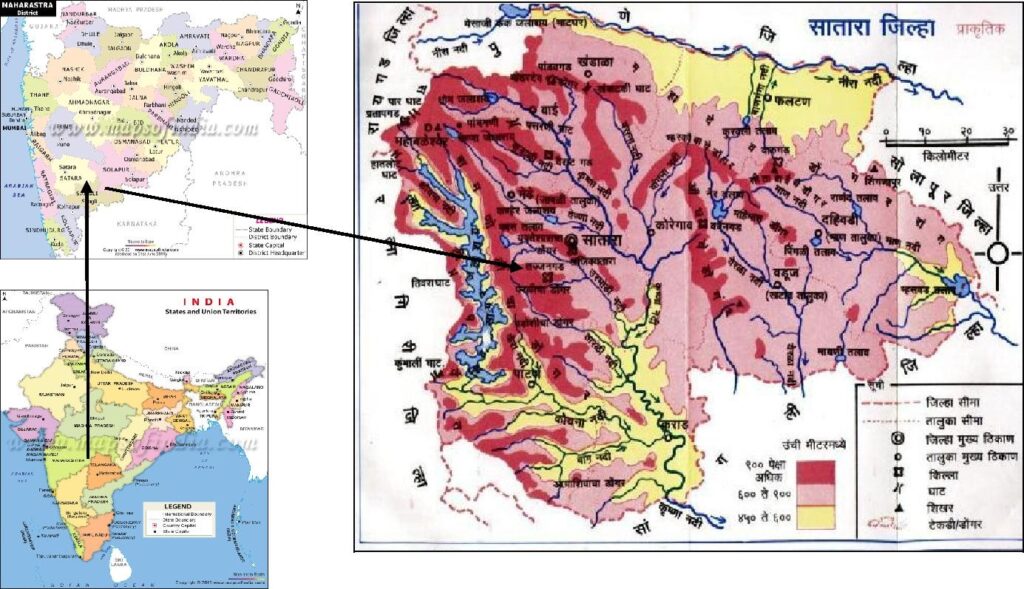
Satara district is located in the western part of Maharashtra. It is bound by Pune district to the north, Solapur district to the east, Sangli district to the south and Ratnagiri district to the west. Raigad district lies to its north-west. The geographical area of Satara district is 10,480 Sq. Km. which is about 3.4 per cent of the state’s total geographical area. Satara district is situated in the river basins of Bhima and Krishna. Panchgani, Mahabaleshwar, Karad, Wai, Koregaon and, Koyananagar are the chief towns of Satara District. Historically Satara was the capital of the Maratha kingdom, land of great warriors, saints and great personalities namely Rani Laxmibai, Krantisinha Nana Patil (Patri sarakar), Savitribai Phule and Karmaveer Bhaurao Patil. This land has rich heritage. Mahabaleshwar, one of the most beautiful hill stations of India, is located in this very district. The physical settings of Satara shows a contrast of immense dimensions and reveals a variety of landscapes influenced by relief, climate and vegetation.
1.2 District at a Glance
1.2.1 Location and Geographical Units:
Satara district lies between 17.5 to 18.11 degree North latitude and 73.33 to 74.54 degree Eastern longitude. The district comprises of 11 tehsils namely Satara, Koregaon, Khatav, Karad, Patan, Wai, Jaoli, Mahabaleshwar, Khandala, Phaltan and Man. Under the Satara Zilla Parishad jurisdiction, 1739 villages are covered through 11 panchayat Samities and 1509 Gram Panchayats. The variation in relief ranges from the pinnacles and high plateaus of main Sahyadrians range having height over 4500 feet above mean sea level to the subdued basin of the Nira river in Phaltan tahasils with the average height of about 1700 feet above mean sea level. The climate ranges from very heavy rainfall in Mahabaleshwar region, which has an average annual all of over 6000 mm to the driest in Man tahsil where the average annual rainfall is about 500 mm. The vegetation cover too varies from the typical monsoon forest in the western parts to scrub and poor grass in the eastern parts.